
How do I help my kid tell b and d apart?
We get this question a lot:
> "Why is it so hard for my kid to tell b and d apart?"

Nothing's wrong, this is normal. EVERY child confuses b and d because of how our brains are wired.
Our brains are rotation invariant by default. If a dog runs past you to your right, and then turns around and runs past you to your left, it's still a dog!
But that's not the case when it comes to reading. If a lowercase "b" turns around, it becomes an entirely new thing. Now it's a lowercase "d"
So to tell "b" and "d" apart, we actually have to untrain some of your brain's default settings. We have to teach it that direction matters. And then we have to teach it which one is b, and which one is d.
The trick that's been most effective for us in Mentava is reminding kids "b has a belly, d has a diaper".
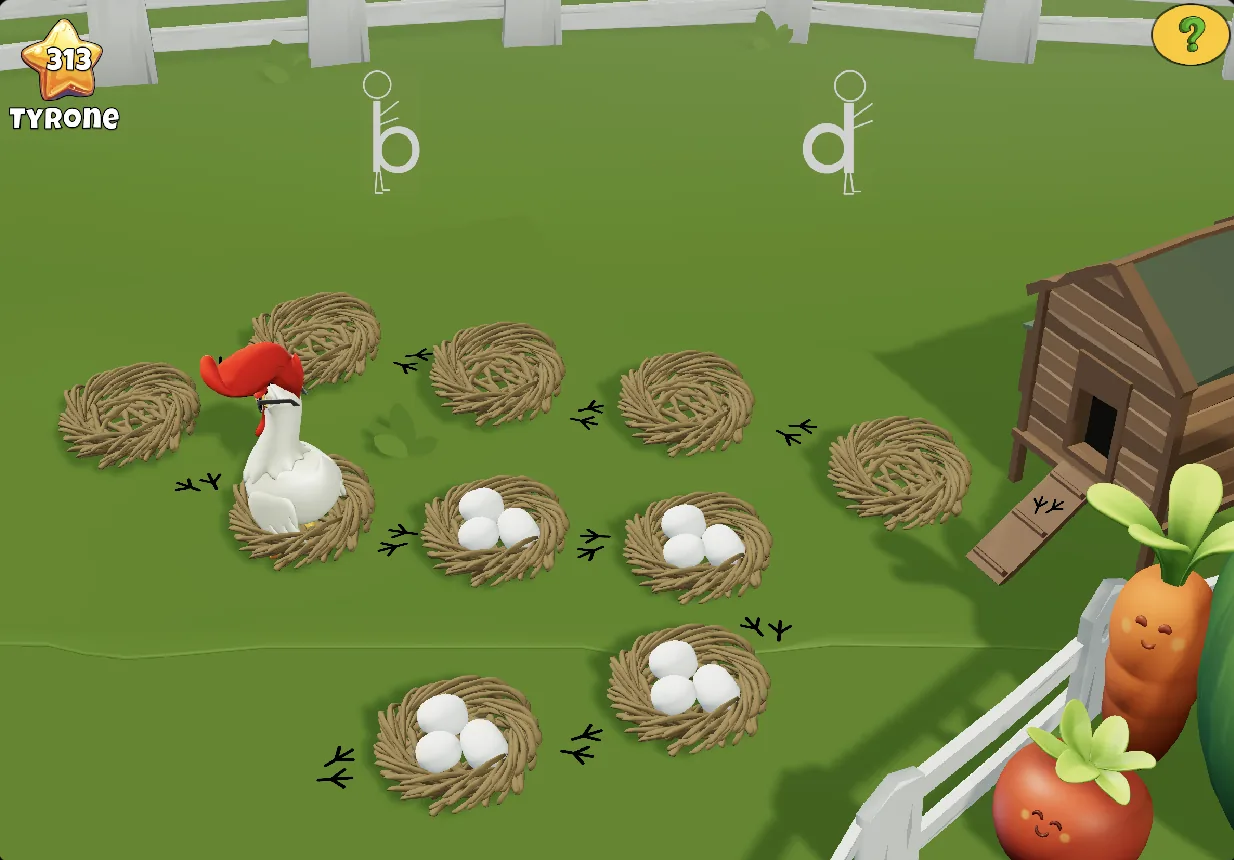
Make sure they can differentiate the stick figures first. Then get rid of the arms and legs but keep asking, "which is belly / which is diaper?"
Once they can reliably tell "belly" from "diaper" (meaning they're understanding that direction matters), you can ask them which is "b" and which is "d".
For young kids, you might even need to ask them "what's the first sound in belly", "what's the first sound in diaper?" Without making that connection, they might not understand why the mnemonic is helpful!
Here are three questions we find helpful to figure out exactly where your child's b/d differentiation is getting hung up:
Can the child differentiate between the belly and diaper stick figures? ("Which is belly? Which is diaper?")
Can the child remember the belly/diaper labels without prompting? (Show the images and ask "which is this one? which is that one?")
Does the child associate "belly" with b and "diaper" with d? ("Is belly b..belly or d..belly? Is diaper b..diaper or d..diaper?")
Remember in all these cases, "b" and "d" are short, clipped sounds - almost a stutter. They are never pronounced "bee" or "dee" or "buh" or "duh".
If the child can do all these three skills, they should be able to reliably differentiate b from d. Their thought process should look something like "This is a belly, b..belly, b!"
(If your child is going through Mentava and is still getting stuck on b and d, please reach out via the Mentava Parent app and let us know! We'll help you diagnose the sticking point, and use that info to improve our lessons to help future students.)
Always break learning down into tiny steps and don't assume kids know the things that you take for granted.
Getting those little details correct makes teaching way more effective.